AV1 was supposed to be the codec that killed royalty fees forever. On March 23, 2026, Dolby Laboratories filed patent infringement lawsuits against Snap Inc. - the company behind Snapchat - in both the U.S. and Brazil, directly challenging that promise.
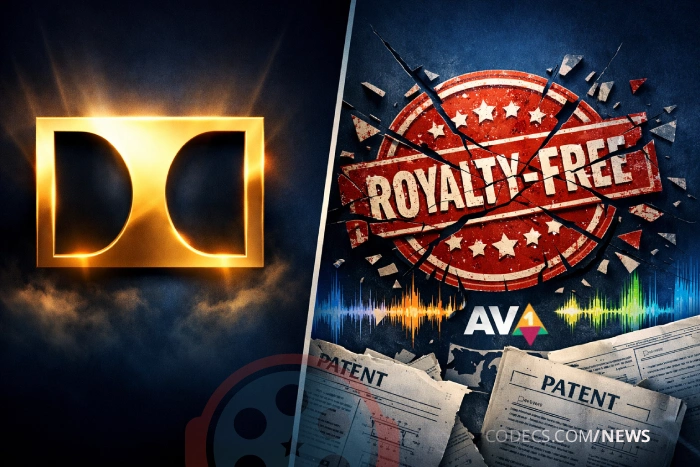
The suits, filed in the U.S. District Court for the District of Delaware and a court in Rio de Janeiro, allege that Snapchat's video processing pipeline infringes four Dolby patents tied to both AV1 and HEVC (H.265).
It is the first AV1 patent assertion against a streaming platform by an Access Advance patent pool licensor.
What Dolby Is Claiming
Dolby points to four specific U.S. patents it says are essential to AV1 implementations: color plane prediction (No. 10,855,990), block merging and skip mode (No. 9,924,193), low-latency sample sequence coding (No. 9,596,469), and entropy coding (No. 10,404,272).
The core argument is blunt. AV1's specification was written after many foundational video compression patents had already been filed. Because AV1 and HEVC share similar block-based coding techniques, Dolby claims its patented methods ended up inside AV1 - without its involvement or consent.
Dolby never joined the Alliance for Open Media (AOMedia), the consortium behind AV1 whose members include Google, Netflix, Amazon, Apple, and Microsoft. Because it made no FRAND (fair, reasonable, and non-discriminatory) commitment for AV1, Dolby argues there is no ceiling on what damages it can claim - and it is asking the court to confirm that in writing.
Why This Matters Beyond Snapchat
Snapchat handles more than 5 billion photos and videos daily. Video accounts for roughly 90% of all Snapchat Stories content.
An injunction blocking AV1 encoding or decoding would directly impair the app's core functionality - and set a precedent that every major AV1 adopter should be watching closely.
Access Advance Had Been Warning Snap Since August 2025
Access Advance, which administers Dolby's patents through its Video Distribution Patent Pool, says it urged Snap to secure a license starting in August 2025. Snap reportedly continued unlicensed use throughout that period.
Because Snap already held an HEVC license through the Access Advance pool, Dolby argues the company was fully aware of the patents and chose not to license them - making the infringement willful. Under U.S. patent law, willful infringement can result in up to triple damages.
Access Advance CEO Peter Moller put it directly: "Labeling a codec 'royalty-free' does not eliminate underlying patent rights".
The Broader Industry Threat
This is not an isolated case. InterDigital is simultaneously pursuing Amazon over AV1 patents tied to Fire TV devices. Patent pools from both Access Advance and the Sisvel Group have assembled AV1 patent portfolios despite AOMedia's royalty-free claims.
IP analyst Florian Mueller summarized the risk plainly: since all modern codecs reuse similar compression techniques, the exposure for companies that treated AV1 as fully free is real and has been systematically underestimated.
Platforms like Netflix, YouTube, and Disney+ - all major AV1 adopters - could face similar claims if Dolby prevails.
Brazil adds an extra layer of urgency. Preliminary injunctions there can move faster than U.S. courts, meaning Snap could face a real enforcement order well before any final verdict in Delaware.
For a broader look at how AV1 stacks up against the codec it was meant to replace, see our AV1 vs H.265 comparison.
If you work with HEVC encoding, the x265 HEVC Encoder remains the most widely used open-source option - and understanding its licensing context just became more important. Our Future of Video Codecs guide covers where AV1, HEVC, and VVC are heading as the legal landscape evolves.
For context on how quickly AV1 was growing before this case landed, see our earlier news piece: AV1 Codec Dominates Streaming Landscape as 2026 Begins.
What Happens Next
Snap has a few paths forward. It could negotiate a license through the Access Advance Video Distribution Pool - the route Dolby clearly prefers. It could argue in court that its AV1 use does not actually infringe those four patents. Or it could move away from AV1 entirely, falling back on AVC or VP9 delivery.
A settlement similar to Roku's January 2026 resolution with Access Advance seems the most likely outcome - but the precedent established before any settlement is reached could reshape how the entire industry licenses open codecs going forward.
Dolby and Snap have both declined to comment publicly. AOMedia has not yet issued a formal response.


How to Stream With VLC: Open a Stream URL or ...
5/5This is amazing! I could no longer afford cable so I cut the cord and started watching Hulu, Youtube, ...
Read More →Don't Open a .xmpeg File Before Reading This
3/5It's never a good sign when the potential malware you downloaded has the EXACT same filename as the example. ...
Read More →Free Popular IPTV Playlist: Where to Get Fres...
3/5How can you create a DSTV channels on IPTV?
Read More →