Most 3GP files open on a current Windows machine without installing anything, so before you go hunting for codecs, it is worth finding out whether yours is one of them.
3GP is the video format old mobile phones recorded to, and it still turns up in phone backups, dashcam footage and CCTV exports.
Windows now includes support for it, so a double-click is a genuinely useful first test rather than a waste of time.
If that fails, one free player fixes it in about a minute, and the rest of this page is only for the files that need more than that.
Step one, and it takes five seconds
Double-click the file and see what happens. Microsoft lists 3GP, 3G2 and AMR among the formats Windows Media Player handles on its own, so a reasonable number of these files simply play.
If it plays, you are done and there is nothing to install. If it opens with sound but no picture, or picture but no sound, or refuses outright, carry on.
Step two: the one-minute fix
Install VLC Media Player and drag the file onto it.
VLC carries its own decoders rather than relying on what Windows has, which is why it opens 3GP files that nothing else on the machine will touch. There is no configuration and nothing to enable.
This is the answer for almost everybody. If you only have a handful of old phone videos to watch, stop here - installing a player is less work than installing filters, and it cannot break anything else on the system the way a codec pack can.
If you would rather not install anything at all, drop the file into our MP4 Player, which runs in the browser and reads 3GP as well.
Why some 3GP files play and others do not
This is the part that confuses people, and it explains why one file from the same phone opens while the next one does not.
The .3gp extension describes a container - a box - and not the video inside it. What Windows actually has to decode is whatever that box happens to be holding.
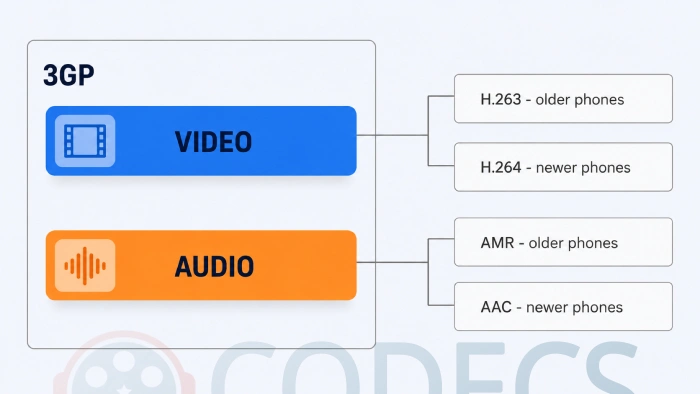
A clip from a mid-2000s feature phone holds one combination; a clip from a phone ten years newer holds another entirely. Same extension, different contents, different chance of playing.
Our Codec Finder reads a file and tells you exactly what is inside it, which turns guesswork into a two-second answer. If the idea is new to you, containers and codecs covers it properly.
If you want it working in the player you already use
Some people would rather not add another player, particularly if their whole library is already set up somewhere else.
In that case you install decoders into Windows itself, and the files then open in MPC-HC, MPC-BE and anything else that uses the system decoders.
- The light option. LAV Filters is the maintained decoder set almost everything else is built on - install it and leave the defaults alone.
- The complete option. The K-Lite Codec Pack bundles LAV Filters with a player and a renderer, which is more than you need for 3GP but covers everything else at the same time.
Either one is a single install with no checkboxes to hunt through, which is a meaningful change from how this used to work.
About the advice you may have read elsewhere
If you have been told to install ffdshow and tick boxes for AMR and H.263, that advice is old and it is worth knowing why rather than assuming you did it wrong.
ffdshow stopped being developed in 2012. Its own project pointed users at LAV Filters at the time, and the last build shipped in 2014. ffdshow is still downloadable and it will still decode an old 3GP, but it has had no security or compatibility work through the entire life of Windows 10 and Windows 11, and nothing it does is not done better by LAV Filters now.
The same applies to Haali Media Splitter, abandoned around the same time. Neither is a trap exactly, but neither is the right answer in 2026, and following those instructions is why some people end up with a machine full of filters and a file that still will not open.
Converting, if you want to keep these files
Old phone videos are worth converting rather than re-solving every few years, because the formats inside them keep drifting further from what anything plays by default.
Converting to H.264 in an MP4 container gives you a file that opens on any phone, any TV and any browser without a decoder in sight.
- Install HandBrake and drag your 3GP files into it.
- Pick a preset - Fast 480p30 is plenty for footage that was shot on a phone camera two decades ago.
- Start the queue and keep the originals until you have checked the results.
XMedia Recode does the same job with more control if you want to set the audio track by hand, which matters when the source is AMR.
When the picture works but there is no sound
This is the single most common half-failure with 3GP, and it is almost always the audio track rather than the video.
Old phones recorded speech in AMR, a codec built for phone calls rather than for music, and it is the part of the file most likely to go unsupported. Our guide on how to play AMR files covers that side of it in detail.
If you want to understand where in the chain things break down generally, the four stages every video goes through is the background reading.
Quick questions
Do I need a special 3GP player?
No, and the ones named after the format are mostly abandoned. A current general-purpose player opens 3GP without any special handling.
Why does one 3GP file play and another one not?
Because 3GP is a container and different phones filled it with different codecs. The extension tells you almost nothing about what is inside.
Should I install ffdshow?
No. It stopped being developed in 2012 and its own project recommended moving to LAV Filters, which is what you should install instead if you need system-wide decoders.
Is 3GP the same as MP4?
They are close relatives - 3GP is a simplified version of the MP4 container built for early mobile networks. That family resemblance is why some players treat them identically.
Can I play 3GP on my phone?
Usually yes, since most Android video players handle it. Converting to MP4 first is still worth it if you plan to share the files.
Will converting lose quality?
A little, because you are re-encoding already-compressed video. It is rarely noticeable on footage shot at phone-camera resolutions, and keeping the originals costs nothing.
Try opening it first, reach for one player if that fails, and convert the ones you actually want to keep.
Download VLC Media Player if your file will not open, or tell us which step worked and what device the footage came from.
More options for playback sit in the media players section.