Android 17 arrived in June 2026 with support for H.266, the newest video format from the group behind H.264 and H.265. Your phone almost certainly still cannot play an H.266 file, and Google has been unusually open about why.
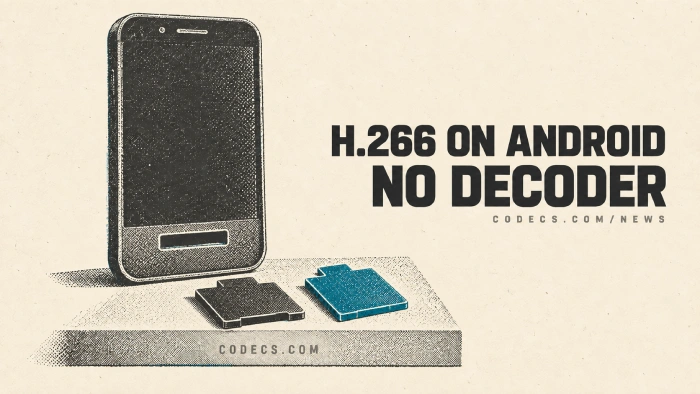
H.266 is also called VVC, short for Versatile Video Coding.
It is the official successor to H.265, promising the same picture in a smaller file.
What Android added is narrower than the headline suggests, and the detail is the whole story.
What Android 17 actually added
Android now recognises H.266 as a format. It knows the media type, and it can read H.266 video out of an MP4 file and hand it to a decoder.
What it does not include is the decoder. Google's own documentation states plainly that Android provides no software decoder for VVC and relies on ones supplied by chip vendors.
That is the difference between recognising a format and being able to play it, and it is an unusual gap.
Why that gap matters so much
Compare it with AV1. When a phone has no AV1 hardware, Android falls back to decoding in software, which is slower but works on almost anything.
H.266 has no fallback at all on Android. If the chip in your phone cannot decode it, nothing on the device can, and no app or update will change that.
Support is not automatic even on capable hardware. A phone maker enables H.266 by declaring the decoder in a system configuration file, and can simply leave it out.
There is no H.266 recording either
Android 17 adds playback only. There is no encoding support of any kind, so no Android phone will be recording video in H.266.
That matches the pattern across the industry, where decoding always arrives years before encoding.
On a desktop it is a different story. uvg266 is a free open-source H.266 encoder for Windows, Mac and Linux, if you ever want to make VVC files rather than only play them.
Why H.266 lost to AV1 in the first place
The technology is not the problem. H.266 was finished in 2020 and compresses very well.
The problem is licensing. Using H.266 commercially means paying patent holders, and the terms took years to become clear, while AV1 was free from the start.
Streaming services picked the free one, which is why AV1 rather than H.265 is the format you are actually watching. Six years after H.266 was finished, Android is only now able to recognise it.
What to do if someone sends you an H.266 file
On a phone, assume it will not play and do not go looking for a codec to install. There is nothing to install.
On a computer, FFmpeg has decoded H.266 since version 7.1 and can convert the file into something ordinary in one command.
Convert it to H.264 for guaranteed compatibility, or to AV1 if the people receiving it have recent devices. Our codec checker will tell you what a given machine handles.
If it is AV1 rather than H.266 that is giving you trouble on a phone, that is a different and much easier problem - see How to Get the AV1 Codec on Android.
The pattern worth noticing
H.266 finished in 2020 and reached Android in 2026, without a decoder. AV2 was finished in May 2026 and nothing plays it yet either.
New video formats take most of a decade to become ordinary, every time, and the ones that get there fastest are the ones nobody has to pay for.
For where the current formats stand against each other, we keep a running comparison in Best Modern Codecs and a longer view in The Future of Video Codecs.
The short version
Android 17 can recognise H.266, but only a phone whose chip already decodes it will play anything, and there is no software fallback coming.
Download FFmpeg if you have an H.266 file to deal with, or tell us if your phone plays one - we would genuinely like to know which ones do.


Don't Open a .xmpeg File Before Reading This
3/5It's never a good sign when the potential malware you downloaded has the EXACT same filename as the example. ...
Read More →Free Popular IPTV Playlist: Where to Get Fres...
3/5How can you create a DSTV channels on IPTV?
Read More →EAC3 Audio Not Supported in MX Player? Fix It
4/5EAC3 Audio Not Supported in MX Player? Fix It
Read More →