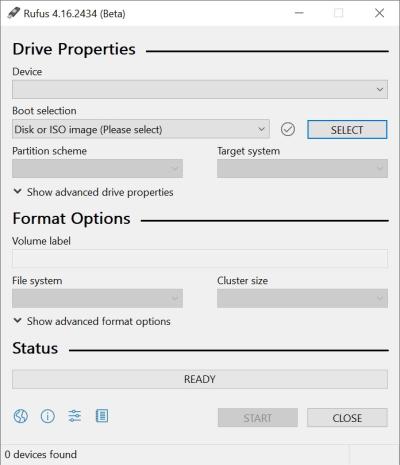
Rufus is a free, portable Windows tool that turns an ISO file into a bootable USB stick for installing or repairing Windows and Linux, and it can also build a Windows 11 installer for unsupported PCs.
- Updated
- Size
- 1.90MB
- Downloads
- 32.6K
- This week
- 172down 32% on the week beforeSee the Top 20 downloads this week
Rufus turns an ISO file and a USB stick into a drive your PC can start from, ready to install or repair Windows or Linux.
It is a single 2 MB program that runs without installing, and it is free and open source with no ads.
For a Windows 11 install stick, it can also skip the TPM check and the forced Microsoft account.
What Rufus Actually Does
An ISO is a disc image, a single file holding everything that would be on an install DVD. Copying it to a USB stick does not make the stick bootable, so Rufus writes it in a way your PC's startup firmware can read.
Pick the stick, pick the ISO, press Start. Rufus chooses the right partition layout and file system for the image, so most people never touch the other settings.
- Windows and Linux. Install sticks for Windows 8, 10 and 11, and live or install drives for most Linux distributions, plus FreeDOS.
- Old and new PCs. Drives that start on both older BIOS machines and modern UEFI systems, with Secure Boot left on.
- Linux persistence. A storage partition so a live Linux stick keeps your files and settings between restarts.
- Drive checks. A bad-block scan that also catches fake flash drives that claim more space than they have.
- ISO download. Fetches official Windows 8, 10 and 11 ISOs from Microsoft if you do not have one.
- File systems. FAT32, NTFS, exFAT, UDF, ReFS and ext2/ext3 for formatting.
It is also fast. The developer's own tests put it at about twice the speed of older tools such as UNetbootin when writing a Windows install drive.
Windows 11 Without the Hurdles
When you write a Windows 11 ISO, Rufus shows a short list of options before it starts. These change how the finished stick installs Windows, not Windows itself.
- Hardware checks. Remove the TPM 2.0, Secure Boot and 4 GB RAM requirements for older PCs.
- Local account. Skip the forced Microsoft account and set up a normal local user instead.
- Privacy. Answer the data-collection questions "no" automatically, and turn off automatic BitLocker encryption.
- Quality of life. New in 4.14, an option to keep Teams, Outlook, Copilot and other bundled extras from being pushed onto the new install. The 4.16 beta adds bringing back the classic right-click menu to the same option.
Our step-by-step guide to installing Windows 11 on unsupported hardware with Rufus walks through each option. If you would rather stay with Microsoft's own route, the Windows 11 Installation Assistant upgrades supported PCs in place.
Careful with silent installation:
The Silent installation option added in 4.14 installs Windows on the first disk it finds, without asking. Leave it unticked unless the target PC has only one disk and nothing on it you want to keep.
How to Make a Bootable USB
- Plug in a USB stick of at least 8 GB for Windows, or 4 GB for most Linux images. Everything on it will be erased, so copy off anything you need first.
- Open Rufus. It lists only removable drives by default, which keeps your internal disks out of harm's way.
- Click Select and choose your ISO, or use the arrow next to it and pick Download to fetch Windows from Microsoft.
- Leave Partition scheme and File system on the values Rufus picks, unless a guide for your PC says otherwise.
- Press Start, confirm the warning, and wait for the green Ready bar.
Not sure which stick to buy? Our comparison of a USB stick vs an SSD covers speed and size. A fast USB 3 stick cuts writing time noticeably.
Which Download to Take
The Rufus download page carries several builds of the same program. None of them installs anything; the difference is where the program can run and where it saves its settings.
| File | Take it if |
|---|---|
| rufus-4.16_BETA.exe | You want the newest fixes and USB 4 support now, and accept a test build. 64-bit Windows only. |
| rufus-4.15.exe | You have a normal 64-bit Windows 8, 10 or 11 PC. This is the safe default until 4.16 is final. |
| rufus-4.15p.exe | You run it from a USB stick and want settings saved in a file next to it instead of the registry |
| rufus-4.15_arm64.exe | Your PC has a Snapdragon or other ARM processor |
| rufus-4.15_x86.exe | Your Windows is 32-bit |
| rufus-3.22.exe | You are still on Windows 7, which Rufus 4 no longer supports |
Rufus 4 needs Windows 8 or later to run. If you are keeping an old machine going, our guide to Windows 7 in 2026 covers the safety side.
What Is New in the Rufus 4.16 Beta
The 4.16 beta arrived on 30 October 2026, mostly fixes plus a long list of security patches. Expect the final release once testing is done; until then 4.15 stays the stable choice.
- Media checks that work. A workaround for a bug in the NTFS driver found on many AMI-firmware PCs, so the option to verify the USB stick when it starts finally works on those machines.
- Faster USB recognised. USB 3.2, USB 4 and USB 4.1 drives are now reported at their real speeds.
- Windows install fixes. Silent installation no longer turns on when its conditions are not met, local usernames can contain dots again, and the time zone is no longer duplicated on non-English systems.
- Classic right-click menu. The quality-of-life option can now restore the old Windows 11 context menu on the new install.
- Updates and security. GRUB 2.16, Microsoft's new revocation list address, and fixes for several reported vulnerabilities.
What Changed in Rufus 4.15
Version 4.15 arrived on 30 June 2026 and is mostly a fix-up release for the big Windows changes in 4.14.
- Silent install fixed. It no longer stops at 75%, and it has stricter guards before it runs.
- ARM fixes. A boot crash on Snapdragon X laptops using UEFI:NTFS is gone, and RISC-V 64 support is added.
- Security. A flaw in the XML parser Rufus uses was closed.
- Windows ISOs. An endless loop with ISOs holding several Windows images is fixed, along with OneDrive removal and username checks.
What People Use It For
Repair is the big one. A stick from Rufus starts a PC that will not boot, and our guide to creating a bootable USB recovery drive shows how to use it.
Clean installs come next, on laptops with no disc drive or on a PC you want to wipe and start fresh. Running a live Linux stick to try a distro or rescue files without touching the hard drive is a close third.
Rufus can also build Windows To Go drives, a full Windows you carry on an external disk. Our guide to a portable Windows installation on SSD covers that setup.
When Another Tool Fits Better
The tell is how many ISOs you want on one stick. Rufus writes one image per drive and wipes it each time, which is ideal for a single job and tedious for a toolkit.
- Ventoy makes a multi-boot stick where you simply copy ISO files on, with no reformatting between them.
- YUMI is another multi-boot builder with a menu of distros to pick from.
- balenaEtcher is the simplest for Raspberry Pi SD cards and IMG files, and runs on Mac and Linux too.
- WinToUSB focuses on portable Windows drives, with more control than Rufus offers.
- Flyoobe upgrades an existing PC to Windows 11 in place, skipping the hardware checks, without making a stick at all.
To back up a whole disk rather than make an installer, Clonezilla is the free cloning tool, and it boots from a Rufus-made stick.
Tools That Pair Well With It
Have an install disc instead of an ISO? ImgBurn reads it into an ISO that Rufus can write.
To peek inside an ISO before writing it, 7-Zip opens it like a folder. To test an ISO without a spare PC, run it in a virtual machine with VMware Workstation Pro first.
The SSD and USB Tools category has the rest of the drive and boot utilities.
Quick questions
Is Rufus safe and free?
Yes. It is free, open source under the GPL, digitally signed by its developer, and has no ads or bundled offers.
Does Rufus need to be installed?
No. Every build runs straight from the file you download. The portable version only differs in saving its settings to a file beside it.
Can Rufus make a Windows 11 USB for an unsupported PC?
Yes. Tick the option to remove the TPM, Secure Boot and RAM requirements in the dialog that appears after you press Start.
Will Rufus erase my USB stick?
Yes, everything on it. Copy off your files first, and double-check the drive name at the top before pressing Start.
Does Rufus work on Windows 7 or XP?
Rufus 4 needs Windows 8 or later. Use Rufus 3.22 on Windows 7. Current versions do not run on XP or Vista.
Is there a Rufus for Mac or Linux?
No, it is Windows-only. balenaEtcher is the usual choice on a Mac or a Linux PC.
Download Rufus 4.16 beta or 4.15 and make your bootable stick, or tell us how you got on if you have used it before.
Available files
- Rufus 4.16 BETAWindowsInstaller1.9 MB
- Rufus 4.15WindowsInstaller1.9 MB
- Rufus 4.15 - portableWindowsPortable1.9 MB
- Rufus 4.15 - Windows ARM64WindowsARM64Installer5.2 MB
Be the first to review Rufus 4.16 beta
Thanks, it's in!
Your review will appear once it has been checked.
Related to Rufus
More free downloads to try-

ImgBurn Closest match
ImgBurn is a free, lightweight disc burner for Windows that writes ISO images to CD, DVD and Blu-ray and verifies every burn.
Mentioned in our Rufus write-up
-

BurnAware Free Top rated
BurnAware Free is a small, home-use disc burner for Windows that writes data, audio, video and bootable CDs, DVDs and Blu-rays, and makes ISO images.
In common: bootable, iso
-

UltraISO
UltraISO Premium is EZB Systems' paid ISO image editor and converter for Windows, last updated in 2021 and still sold with a limited free trial.
Popular in HDD, SSD and USB