Your Samsung TV refuses an AVI file that plays perfectly on your PC - and the fix takes about a minute, with no re-encoding and no quality loss.
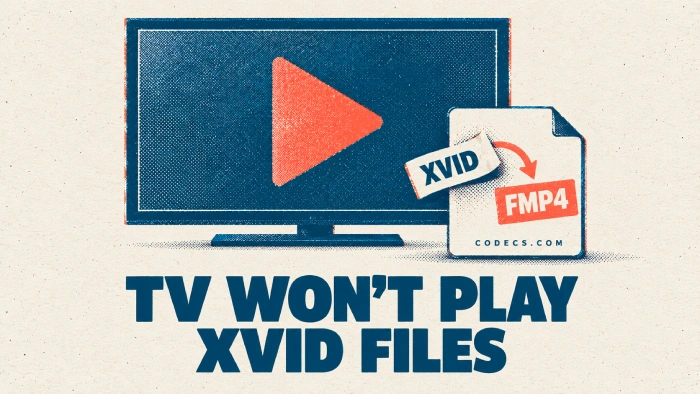
The usual advice is to convert the whole library to MP4, which takes hours and costs you a little quality every time.
There is a shortcut, and it changes four letters instead of the video.
It works on many Samsung QLED sets, and on plenty of other TVs with the same fussiness.
Why the TV Says No
Every AVI file carries a four-character code in its header, called a FourCC, that announces which decoder the video needs. An Xvid codec file usually says XVID; DivX files say DIVX, DX50 or DIV3.
Xvid and DivX are both MPEG-4 Part 2 video, which these TVs decode happily. The firmware simply checks that tag first, and some codes are not on its list.
So the picture never gets a chance. Change the tag to one the TV accepts and the same file plays, because the video inside the container never changes.
Check the file first. Play it in VLC on your computer. If it stutters or fails there too, the file itself is damaged and no tag change will help.
Which Code to Use
| If your file says | Change it to | What that code means |
|---|---|---|
| XVID, DIVX or DX50 | FMP4 | MPEG-4 Part 2, the tag FFmpeg writes |
| DIV3 or DIV4 | MP43 | Microsoft MPEG-4 version 3 |
| Still refused after FMP4 | MP42, MP43 or SEDG | Other MPEG-4 tags, SEDG being Samsung's own |
The Fix, Step by Step
- Work on a copy. Duplicate the AVI first, so the original is safe if your TV turns out to want a different code.
- Open it in the tool. AVI FourCC Changer is a free 135KB utility that does this one job and nothing else.
- Type the new code and save. Use the table above - the file size does not change, because only the header is rewritten.
- Copy it to the TV. A USB stick or your usual network share, then play it as normal.
The Same Fix in One Command
If you have a lot of files, or you would rather not install an old utility, FFmpeg does the same thing from the command line.
ffmpeg -i input.avi -c copy -tag:v FMP4 output.aviThe -c copy part is what matters: it copies the video and audio across untouched and only rewrites the tag, so the job finishes in seconds.
It Plays, but It Stutters
Some older Xvid and DivX files pack their frames in a way TVs handle badly, and that can show up as jerky playback once the file finally opens.
This command repacks them, still without re-encoding:
ffmpeg -i input.avi -c copy -bsf:v mpeg4_unpack_bframes -tag:v FMP4 output.aviNo sound is a different problem.
If the picture plays and the audio does not, the tag is not to blame - the file's audio track is something your TV cannot decode. Our guide to every other Xvid playback fault covers that one.
When Nothing Works, Convert
A handful of files will still be refused, usually because the resolution or frame rate sits outside what the TV supports.
For those, HandBrake converts to MP4 with H.264, which every modern TV plays. It takes longer and costs a little quality, which is exactly why it is the last resort rather than the first.
Quick questions
Does changing the FourCC hurt the video quality?
No. Only a few bytes in the file header change, and the video and audio are left exactly as they were. That is the whole appeal compared with converting.
Will the file still play on my computer afterwards?
Yes. VLC, MPC-BE and most other players decode the video whatever the tag says, so the file works in both places.
Does this work on TVs that are not Samsung?
Often, yes. Any TV that refuses a file on the basis of its codec tag can be fooled the same way, so it is worth two minutes on an LG, Sony or Philips set too.
My TV still refuses the file. What now?
Try MP42, MP43 or SEDG before giving up. If none of them work, the problem is probably the resolution, frame rate or audio track rather than the tag, and converting is the answer.
Can I change the code for a whole folder at once?
Yes, with the FFmpeg command above in a simple loop. People have processed thousands of files this way in a few minutes.
The bottom line
Four letters stand between your AVI library and your TV, and changing them takes a minute. Did it work on your set? Tell us which model and which code.



How to Stream With VLC: Open a Stream URL or ...
5/5This is amazing! I could no longer afford cable so I cut the cord and started watching Hulu, Youtube, ...
Read More →Don't Open a .xmpeg File Before Reading This
3/5It's never a good sign when the potential malware you downloaded has the EXACT same filename as the example. ...
Read More →Free Popular IPTV Playlist: Where to Get Fres...
3/5How can you create a DSTV channels on IPTV?
Read More →