Almost every number printed on a headphone box is there to sell you something, and the one thing that decides how they will sound on your head is not printed anywhere.
This guide is about which of those numbers to read and which to ignore.
It names no models, because a list of picks goes stale faster than the advice does.
What it gives you instead is the order in which things actually matter, so you can judge any pair in front of you.
What Actually Changes What You Hear
In rough order of how much difference each one makes, it goes: the seal around your ears, the tuning the maker chose, the recording you are playing, and only then the wireless link. Most shopping advice has that list upside down.
The seal comes first because it is the one part that changes from person to person. The same headphones lose bass and isolation the moment the pads stop making full contact, which is why glasses arms, a large head, thick hair or a worn-flat pad can change the sound more than an upgrade would.
Tuning comes second, and it is the thing no spec on the box describes. Two models from the same maker, in the same range, can be deliberately voiced in opposite directions, one bass-forward and one flat.
The Two Numbers That Tell You Nothing
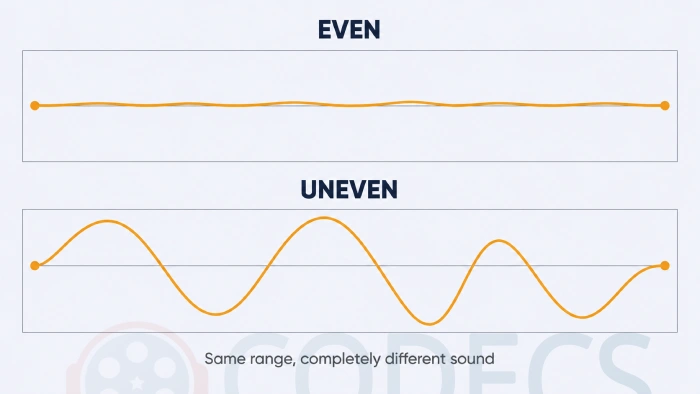
Frequency response range. A headphone advertised as 20 Hz to 20 kHz, or 10 Hz to 40 kHz, is telling you only that some sound emerges at those frequencies. It could be far too quiet to hear.
The number that would mean something is the tolerance, written as something like plus or minus 3 dB, which says how evenly the range is reproduced. Almost no consumer box prints it, and a pair that reaches 40 kHz with a wildly uneven midrange sounds worse than one that stops at 20 kHz and is level.
Driver size. A 50 mm driver is not better than a 40 mm one, and the belief that it is has been sold to gamers for years. Enclosure, pad and tuning decide the sound, and a well-tuned smaller driver regularly beats a poorly implemented larger one.
The quickest test of a spec sheet. If the impressive numbers are the range and the driver size, and there is nothing about tuning, pad material or a tolerance figure, you are reading marketing rather than engineering.
Open-Back or Closed-Back
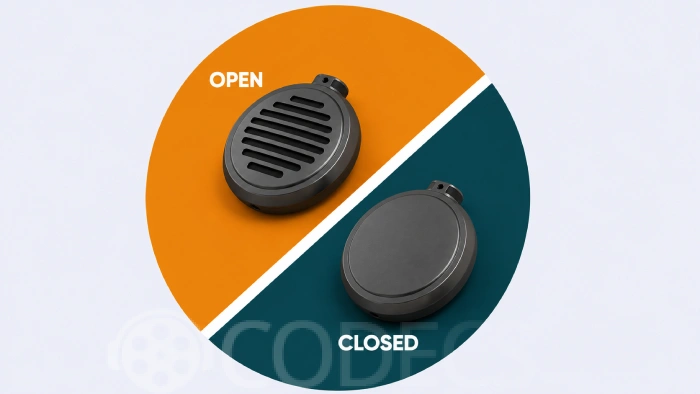
This is a real decision and it is decided by your room, not by your game. Open-back cups vent to the outside, which usually gives a wider and more natural sense of space, and it also means everyone near you hears what you are hearing.
Closed-back cups seal, so they keep sound in and noise out, and they tend to give tighter close-range imaging and more bass weight. In a shared room, on a train, or with a microphone open, closed-back is the only sensible answer.
For competitive shooters the two camps genuinely disagree, and you should distrust anyone who tells you it is settled. Open-back tends to win in a quiet room, closed-back in a noisy one, and consistent imaging beats a wide but vague soundstage either way.
Wired, 2.4 GHz Or Bluetooth
These are three different things and only one of them is a real problem for gaming. Analogue wired is effectively instant, and a USB headset adds only its own small conversion delay.
A 2.4 GHz dongle typically lands somewhere around 15 to 40 milliseconds, which nobody notices in play. Ordinary Bluetooth is commonly measured in the low hundreds of milliseconds, which you will see as lips and gunshots arriving late.
So the rule is simpler than the usual advice: Bluetooth for music and calls, 2.4 GHz or a cable for anything where timing matters. A headset that offers both is worth more than one that is very good at either.
Ignore aptX as a buying requirement. Samsung dropped the higher aptX codecs from the Galaxy S23 onward and Apple has never supported any of them, so on most phones an aptX headphone quietly falls back to AAC. Work out which codec your phone and headphones will settle on before paying for a badge.
If you want to know rather than guess, you can check what your phone supports in about a minute, and Bluetooth Codec Changer will switch between them without digging through developer settings.
On a PC the picture is different again, because Windows supports far fewer codecs than Android does. There is a separate guide on LDAC on a Windows PC and why it is harder than it looks.
Virtual Surround: Turn It Off For Competitive Play
This is the advice most often given backwards, including by the previous version of this page. Modern shooters already do their own spatial processing for headphones, and adding a second layer on top of it does not sharpen the result.
Two spatial models applied one after the other fight each other. Directional cues get smeared rather than clarified, and footsteps become harder to place, which is the exact opposite of what you paid for.
For competitive play, leave the system-level effect off and set the game itself to headphones or HRTF. Spatial audio is genuinely good for films and single-player immersion, which is a different job, and there is a guide on what Windows Sonic, Dolby Atmos and DTS actually are if you want it for that.
If you do want it on for films, there is a short walkthrough for turning spatial sound on. Just remember to turn it back off before you queue.
What Noise Cancelling Can And Cannot Do
Active noise cancelling and passive isolation are not cheap and expensive versions of the same feature. They work on different parts of the spectrum, and the good news is that they add up.
ANC does nearly all of its work low down, below roughly 1 kHz, where engine rumble and air conditioning live, and very little above about 2 kHz. Passive isolation, which is just pads and a good seal, covers the mids and highs that ANC misses.
This is why ANC does so little about an open-plan office. Speech sits largely where ANC is weakest, so a colleague two desks away comes through nearly intact while an aircraft cabin goes quiet.
Buy ANC if you fly, commute or live somewhere with traffic. If your problem is people talking, spend the money on a well-sealing closed-back pair instead.
The Microphone, If You Talk While You Play
A detachable or retractable boom is worth more than a slightly better capsule, because it lets one headset do two jobs. A mute control you can find without looking is the other thing you will use every session.
Discord and TeamSpeak both still run headset certification programmes, and a certified mic is a reasonable shortcut if you do not want to read reviews. It is a compatibility signal rather than a quality ranking.
Be realistic about the ceiling, though. Even a good boom mic on a headset is a convenience device, and a cheap standalone microphone will beat it if voice quality genuinely matters to you.
What Each Tier Actually Buys
Prices move and vary by country, so here is what changes rather than what it costs.
- Entry. Plastic frames, thin foam pads and one connection type - they can sound fine, but the pads flatten within a year and take the bass with them.
- Mid. Better pads, replaceable parts, a sensible clamp and usually a choice of wired and wireless - this is where the curve flattens and where most people should stop.
- Premium. Metal frames, more careful tuning, better ANC and hi-res codec support - real improvements, but small ones beside the jump from entry to mid.
The upgrade that beats moving up a tier is usually a set of replacement pads for the headphones you already own. New pads restore the seal, and the seal is the thing at the top of the list.
Who Should Look Elsewhere
The tell is what you plan to feed them. If everything you listen to is a standard-quality stream or a folder of low-bitrate MP3s, a better pair of headphones will mostly make the shortcomings easier to hear.
Fix the source first in that case. It is worth settling FLAC against MP3 for your own library, and reading up on whether hi-res audio is worth the money before you spend anything.
The other tell is glasses. If you wear them, clamp force and pad softness matter more to you than any spec on the box, because the arms break the seal, and that is a thing you can only test by putting them on.
Free before paid. Before replacing anything, try Equalizer APO on what you own. Tuning is what you are really buying at every tier, and on a PC you can change it yourself for nothing.
Feeding Them Properly
If you are keeping a lossy library, variable bitrate MP3 is the thing to understand before re-encoding anything. Re-encoding an already lossy file never adds detail back.
For music you own on disc, rip your own discs to a lossless format once and you never have to think about it again. For one-off conversions there is a free online audio converter.
On the codec side, Galaxy owners get Samsung Seamless Codec with Galaxy Buds, and aptX became easier to find after Qualcomm opened aptX up to Android builders.
Looking further ahead, LC3plus is the hi-res option arriving alongside Bluetooth LE Audio.
Quick questions
Are 50mm drivers better than 40mm?
No. Driver size does not predict sound quality, and tuning, pad design and the shape of the cup matter far more. A well-tuned 40 mm driver routinely beats a badly implemented 50 mm one.
Should I turn on virtual surround for gaming?
Not for competitive play. Leave the system-level effect off and let the game do its own spatial processing, because two layers of it blur the direction cues rather than sharpening them. For films and single-player, it is worth having on.
Is a 10Hz to 40kHz frequency range better than 20Hz to 20kHz?
Not on its own. Without a tolerance figure such as plus or minus 3 dB, a range only says that something comes out at those frequencies, not that you can hear it or that the response is even.
Is Bluetooth good enough for gaming?
For casual play, usually. For anything competitive, no, because ordinary Bluetooth delay is commonly measured in the low hundreds of milliseconds against roughly 15 to 40 for a 2.4 GHz dongle.
Will noise cancelling block people talking?
Barely. ANC works mostly below about 1 kHz, and speech sits above where it is effective, so a good passive seal does more about an office than ANC does.
Do I need an expensive pair to hear a difference?
The biggest jump is from entry to mid, and it flattens after that. Replacement pads for the headphones you already own are often the cheapest real improvement available.
Buy for the seal, the tuning and the way you will actually use them, and treat the driver size and the frequency range on the box as decoration.
Work out the codec comparison before you buy a wireless pair, grab Bluetooth Codec Changer for Android to switch between them, or tell us what you ended up with in the comments below.
Nearby: the AAC encoder for the desktop side, and the rest of the Android section.
The audio codec downloads and multimedia tools sections cover everything else.


How to Stream With VLC: Open a Stream URL or ...
5/5This is amazing! I could no longer afford cable so I cut the cord and started watching Hulu, Youtube, ...
Read More →Don't Open a .xmpeg File Before Reading This
3/5It's never a good sign when the potential malware you downloaded has the EXACT same filename as the example. ...
Read More →Free Popular IPTV Playlist: Where to Get Fres...
3/5How can you create a DSTV channels on IPTV?
Read More →