ARTE just dropped a two-part documentary that might make you rethink every scroll, swipe, and like you've ever given TikTok. The series exposes how the world's most addictive app became the frontline of a digital cold war between the US and China.
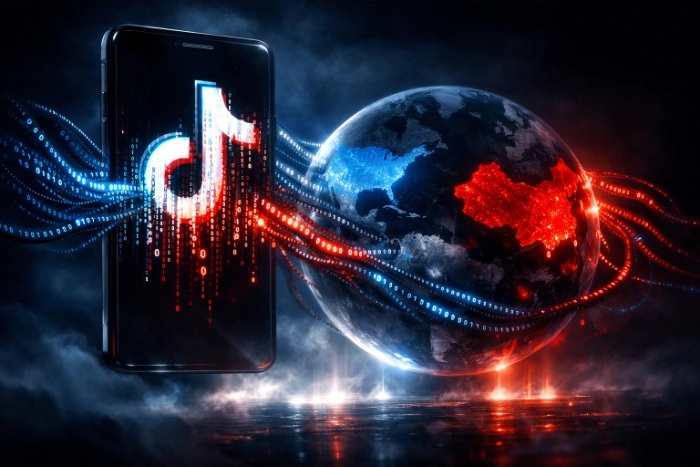
Update: American Ownership, Same Censorship Concerns
The timing of this article couldn't be more relevant. The same week we published our coverage of ARTE's documentary, TikTok's US ownership officially changed hands - and the censorship concerns flipped to the opposite pole.
On January 22, 2026, a consortium of Trump-aligned American investors completed their acquisition of TikTok's US operations.
The new owners include Oracle (led by Trump ally Larry Ellison), Silver Lake, and MGX - an Emirati state-owned AI investment fund. ByteDance retained a 19.9% stake.
Within 72 hours, users reported widespread censorship.
What Users Are Reporting
Content creators across the platform noticed something strange: videos getting zero views, posts vanishing from feeds, and certain words triggering automatic blocks.
The most documented cases involve content about Immigration and Customs Enforcement (ICE) operations in Minneapolis - including the fatal shooting of a US citizen during a raid.
California State Senator Scott Wiener reported TikTok blocked his ICE-related post for several hours. Singer Billie Eilish publicly stated that "TikTok is silencing people".
Perhaps most bizarrely, the word "Epstein" became unsendable in direct messages. Users who attempted to share the name received error messages claiming the content "may be in violation of Community Guidelines." TikTok later said they were "investigating" the issue.
TikTok's Response: Data Center Outage
The company blamed the problems on a "cascading systems failure" following a power outage at an Oracle data center during a winter storm. TikTok stated that creators "may temporarily see '0' views or likes on videos" due to "server timeouts".
The explanation hasn't satisfied critics. California Governor Gavin Newsom announced a formal investigation into whether TikTok violated state law by censoring content critical of the Trump administration. His office stated they had "independently confirmed instances of suppressed content." (PBS NewsHour coverage)
The Irony: Same Algorithm, Different Masters
The original concern about TikTok was that the Chinese Communist Party could use the platform's powerful recommendation engine to shape American public opinion. As tech journalist Jacob Ward noted on PBS NewsHour, the algorithm was "built in China" with "incredible capabilities to detect in real time whether you're saying things it doesn't want you to say".
That same infrastructure now operates under American ownership - specifically, ownership with documented ties to the current administration. The algorithm's capabilities haven't changed. Only the entity controlling it has.
Whether the January incidents were genuine technical failures or early signs of political content moderation remains disputed. What's clear is that the platform's architecture makes both scenarios possible.
New Privacy Policy Concerns
The ownership transfer also brought updated terms of service that raised eyebrows among privacy advocates. The new policy explicitly allows TikTok to collect:
- "Citizenship or immigration status".
- "Precise location data" (previously the US app stated it did not collect GPS data).
- Expanded tracking capabilities across other platforms and websites.
The Electronic Privacy Information Center (EPIC) called the take-it-or-leave-it terms problematic:
"If the only choice is to accept the unnecessary collection and use of your location data, your citizenship data and other sensitive data, or not use the app at all, that's not a real choice".
The documentary's core message remains relevant regardless of who controls TikTok: your data on any social platform can be weaponized for purposes you never intended.
This story is developing. We'll update this article as Governor Newsom's investigation produces findings.
"TikTok: Under the Influence" - directed by Vincent de Cointet and first aired in April 2025 - traces how a video-sharing app built for dance challenges quietly became one of the most powerful surveillance and influence tools on the planet.
With 1.7 billion users worldwide, the stakes go far beyond viral trends.
From Startup to State Tool
The story begins in 2012, when Chinese engineer Zhang Yiming founded ByteDance during a period of economic openness.
His company would go on to create Douyin for the Chinese market and its international twin, TikTok, powered by the same algorithm.
But ARTE's investigation reveals the turning point most users never heard about.
The Chinese Communist Party systematically took control of ByteDance and other tech companies, requiring them to hand over data and applications.
The documentary argues this gave Beijing a dual advantage - domestic surveillance and a direct challenge to American digital dominance.
The Algorithm That Reads Your Mind
The most unsettling part of the documentary focuses on TikTok's recommendation engine. Through interviews with cognitive science researchers and former content moderators, the series shows how the algorithm doesn't just serve content you like - it shapes what you think.
From amplifying specific narratives to quietly suppressing others, TikTok's algorithm operates as what experts in the film describe as an extension of Chinese soft power.
If you've ever wondered why certain topics trend while others vanish, this documentary offers some uncomfortable answers.
Why This Matters for Your Privacy
The documentary highlights how personal data collected through social media apps can be weaponized for geopolitical purposes.
If you're concerned about your digital footprint, consider using privacy-focused tools like Brave Browser for everyday browsing, or Tor Browser for situations requiring maximum anonymity.
Regularly clearing your digital traces with Privacy Eraser Free is another practical step toward protecting your data.
The US-China Showdown
The second episode dives into Washington's response. The Huawei affair kicked off the tech decoupling between the two superpowers, and TikTok quickly landed in the crosshairs.
In April 2024, Congress passed a near-unanimous law forcing ByteDance to sell TikTok's US operations or face a ban.
Then came the twist. After his re-election, Donald Trump reversed course and granted ByteDance a 75-day reprieve - a move the documentary frames as part of a larger pattern of contradictory Western responses to Chinese tech influence.
How to Watch
The full documentary is available to stream on ARTE's website, free of charge (available until 10/03/2026) Youtube. Each episode runs approximately 53 minutes.
For offline viewing, tools like 4K Video Downloader let you save web videos for later. And if you prefer a player that handles virtually any format without codec headaches, VLC Media Player remains the gold standard.


Free Popular IPTV Playlist: Where to Get Fres...
5/5Very good👍👍❤❤
Read More →How to Download HEVC Video Extension for Free
5/5its works! thank you all!
Read More →How to Use Helium Audio Converter: Convert An...
5/5@levi Yes, it works offline, it's a desktop software.
Read More →