A maker has printed a two-minute song on one sheet of paper - eight QR codes, folded like a cassette tape.
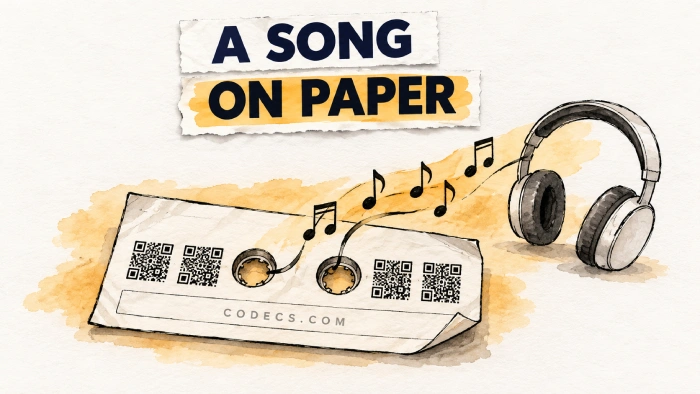
The trick is Meta's EnCodec, an AI audio codec that turned a 2.9MB MP3 into a file of about 21KB.
Scan the codes, feed them to the decoder, and the song plays again.
It is a brilliant stunt, but not a new way to keep your music - and the famous 1,000x figure needs a footnote.
How a song fits in eight QR codes
The project is called Paper Tunes, built by the maker Makestreme and published in August. The song itself is 2 minutes 7 seconds long.
- The AI listens. EnCodec turns the audio into a short stream of tokens at 3 kbps - a description of the sound rather than the sound itself.
- The file is split. The 21KB result is cut into eight chunks of about 3KB, each tagged with a one-byte number.
- Each chunk becomes a QR code. The maker used the biggest QR size there is, with the lowest error correction, to squeeze in as much data as possible.
- Playback runs in reverse. A Python script reads all eight codes from a scan, puts them back in order and hands them to the EnCodec decoder, which rebuilds a WAV file.
Is it really 1,000 times smaller?
It depends what you compare it with. Against the 2.9MB MP3, the 21KB file is about 135 times smaller.
The 1,000x figure holds against the same two minutes as uncompressed CD-quality audio, which takes about 22MB. The MP3 had already done a big chunk of the shrinking before the AI touched it.
What it sounds like
Good enough to recognise, not good enough for your headphones. The EnCodec model used here is mono, and early listeners say it changes the music noticeably.
The maker also tried 1.5 kbps to save space, and the sound fell apart. 3 kbps was the lowest setting that still worked.
The catch: no decoder, no song. The paper does not hold the sound - it holds instructions an AI model needs to redraw it, so the music only exists as long as EnCodec is around to read them.
Paper has its own risks too. With error correction turned down to the minimum, a coffee ring or a bad crease can make a code unreadable.
Radio bonus. The maker also beamed the same 21KB file between two small ESP32 boards over LoRa radio. It took about 90 minutes, because each packet waited 40 seconds to stay inside the legal airtime limits.
An old trick with a new codec
Printing data on paper is not new. In 1985, the Cauzin Softstrip let magazines print software as barcode strips of up to about 5,500 bytes, which readers scanned straight into their computers.
What has changed is the codec. Forty years later, the same kind of paper can carry a whole song instead of a small program.
Want small audio files today?
You do not need an AI model for that. Opus Audio Codec is the everyday champion of small files - clear speech at very low bitrates, good music at a fraction of an MP3's size, and it plays in almost every modern browser.
If you prefer clicking to typing commands, foobar2000 with its Free Encoder Pack converts your music to Opus in a couple of steps.
On a phone, the free Audio Converter shrinks a song to MP3 or OGG right in your browser, without uploading it anywhere.
Curious about the codec itself? Read our explainer on Lyra and EnCodec, the two AI codecs built for very low bandwidth.
Quick questions
Can I play the song with my phone's QR scanner?
No. A normal scanner only shows a jumble of characters, because each code holds raw data, not a link. You need the maker's Python script and the EnCodec decoder to turn it back into sound.
Why not just print the MP3 as QR codes?
It would need close to 1,000 of the largest QR codes. EnCodec's tiny file is what brings it down to eight.
Is EnCodec free to use?
Yes. Meta's AI research team released it in 2022, and its code is open source under the MIT licence. It comes in a mono 24 kHz model and a stereo 48 kHz model trained on music.
Will AI codecs replace MP3?
Not for your music library. They need a heavy AI model to decode and they change the sound, while MP3 and Opus play instantly on almost anything.
The bottom line
Paper Tunes is a clever reminder of how far audio compression has come - just remember the song lives in the decoder as much as on the paper. For small files you can actually use, Opus is the answer today.


How to Stream With VLC: Open a Stream URL or ...
5/5This is amazing! I could no longer afford cable so I cut the cord and started watching Hulu, Youtube, ...
Read More →Don't Open a .xmpeg File Before Reading This
3/5It's never a good sign when the potential malware you downloaded has the EXACT same filename as the example. ...
Read More →Free Popular IPTV Playlist: Where to Get Fres...
3/5How can you create a DSTV channels on IPTV?
Read More →