AV1 is the codec everyone calls royalty-free, and Dolby has gone to court to say that label does not cover its patents.
The case was filed in March 2026 and widened in June.
Both sides have a real argument, which is why it is still running.
Here is each position, and the three ways this ends.
Dolby's Position
Dolby never joined the Alliance for Open Media, the group that built AV1 and promised not to charge for its members' patents. It made no promise, so it says it is owed royalties like any other patent owner.
Its case names AV1 and HEVC patents, many bought from General Electric in 2024, and is running in Delaware and Rio de Janeiro. The filing itself is covered here.
The Alliance's Position
The promise was always specific: members - Google, Netflix, Amazon, Apple, Microsoft, Meta - do not charge for their own AV1 patents. It was never a claim that no patent anywhere touches the format.
The Alliance also argues the format was designed around known patents, so outside claims should be narrow. Proving that takes a court, one patent at a time.
Snap's Position
Snap built AV1 into Snapchat on the understanding that it was free to use. It has not conceded anything publicly, and no ruling has been made public.
Its awkward spot is that switching codecs does not help. The main pool licenses VP9, AV1, HEVC and VVC together, so the alternatives sit under the same licence.
The Position Nobody Argues Out Loud
Device and app makers just want a price. Sisvel publishes its AV1 rate at about 0.32 euros per screen device, which is trivial per unit and serious across millions.
That is why a new AV1 pool started forming in August 2026, and why H.266 - paid, but licensed through mostly one pool - suddenly looks tidy. That reversal is covered in how the lawsuit gave H.266 a second look.
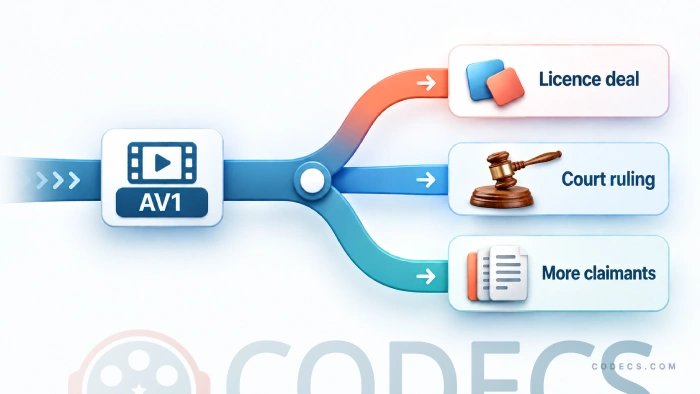
The Three Ways This Ends
- A licence deal. The usual ending, and it would quietly set a price for AV1 that nobody advertised.
- A court answer. Slower and riskier - a ruling either way would tell every other patent owner whether to file.
- More claimants. The pool being built suggests this is the direction of travel, licence by licence rather than case by case.
What It Changes for You
Nothing. Watching, converting and storing AV1 files is not what any of these licences cover, and no case has been aimed at a viewer.
If an AV1 file will not play, it is a missing decoder - on Android, here is how to fix that, and on Windows the AV1 codec page has the options.
Quick questions
So is AV1 royalty-free or not?
Free for viewers, always. For companies it is free of the Alliance members' patents only, and Dolby's case is about patents held outside that group.
Could AV1 be taken away?
No. It is already in Netflix, YouTube, browsers and most recent phones. What is being decided is who pays whom.
Who ends up paying?
Chip, device and app makers, through licences that are already priced into whatever you bought. Never the person watching.
Source: Access Advance announcement of the AV1/AV2 patent pool.
The bottom line
Royalty-free meant free from the people who built AV1, not free of patents - and that gap is what the court is being asked to price.


Don't Open a .xmpeg File Before Reading This
3/5It's never a good sign when the potential malware you downloaded has the EXACT same filename as the example. ...
Read More →Free Popular IPTV Playlist: Where to Get Fres...
3/5How can you create a DSTV channels on IPTV?
Read More →How to Download HEVC Video Extension for Free
5/5Does anyone have the HEVC Video Extensions as an .exe file and can provide a download link?
Read More →