Windows already mounts ISO files on its own - ImgDrive is the free tool you need for every other kind of disc image, from BIN/CUE to NRG.
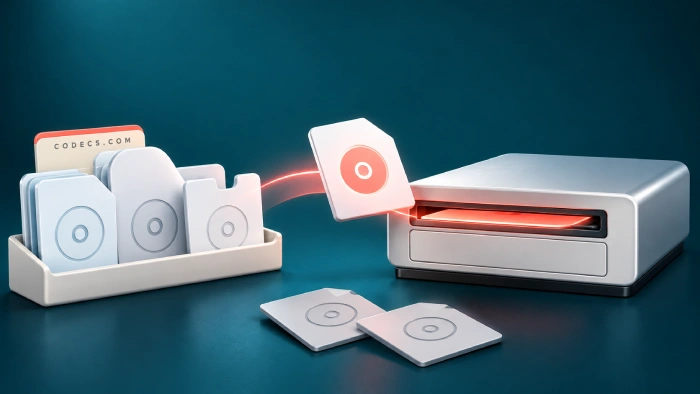
Mounting a disc image means telling Windows to treat a file on your hard drive as if it were a disc sitting in a drive.
No burning, no blank discs, no waiting.
The problem is that Windows only does this for one or two formats, and the file you downloaded is often not one of them.
So this guide starts with the free thing you already have, then shows you what to do when it is not enough. Most people need about ninety seconds of it.
If You Have an ISO, You Do Not Need to Install Anything
Windows 8, 10 and 11 all mount .iso files by themselves, and almost nobody knows it.
Right-click the file in File Explorer and choose Mount. Windows creates a new drive letter, opens it, and the contents appear exactly as if you had put a disc in.
When you are finished, right-click that drive under This PC and choose Eject. The drive letter disappears and the image file is untouched.
If Mount is missing from the menu. Something else has claimed the ISO file type, usually WinRAR or 7-Zip. Right-click the file, choose Open with, then Choose another app, and set Windows Explorer as the default for ISO files.
Sorry, there was a problem mounting the file. Windows shows this when the ISO sits on a network drive, when the file is NTFS-compressed or sparse, or when no drive letter is free. Copy the file to a normal local folder and try again - that clears it nearly every time.
Everything Else Is Where Windows Stops
Disc images come in a dozen formats, because every burning program invented its own. Windows understands two of them.
Find your file extension in the table below before you install anything.
| Extension | What it is | Windows mounts it? |
|---|---|---|
| ISO | The standard copy of a CD, DVD or Blu-ray | Yes, right-click and Mount |
| IMG | A raw sector-for-sector copy | Usually, same right-click |
| BIN + CUE | Data in the BIN, track layout in the CUE - you need both | No |
| NRG | Nero Burning ROM's own format | No |
| MDS + MDF | An Alcohol 120% pair, again two files | No |
| CCD | A CloneCD set, usually with IMG and SUB alongside | No |
| ISZ | A compressed ISO, made by UltraISO | No |
| CUE + FLAC, APE or WAV | A ripped audio CD kept as one long track plus an index | No |
If your file is in the bottom six rows, a virtual drive program is the short way out.
Why ImgDrive
ImgDrive is a 1.2MB freeware virtual drive from Yubsoft that mounts every format in that table, plus audio CD images. It installs in seconds and then mostly stays out of your way in the notification area.
The obvious rivals are all heavier than it, in one way or another.
- Daemon Tools Lite is a 45MB download with extras offered during setup.
- Alcohol 52% is free and still works, but it has not moved in years.
- UltraISO and PowerISO are shareware, and they will keep reminding you.
How to Mount a Disc Image With ImgDrive
There are three routes to the same result, and the first one is the only one most people ever use.
- Install it. Download ImgDrive and run the installer, or take the portable build if you would rather not install anything.
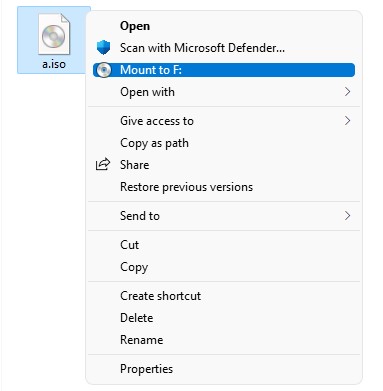
- Right-click your image file in File Explorer. ImgDrive adds a Mount to F: entry to the menu, naming the next free drive letter - one click and you are done.
- Or use the tray icon. Click ImgDrive in the notification area, hover the drive you want, and choose Mount Image.
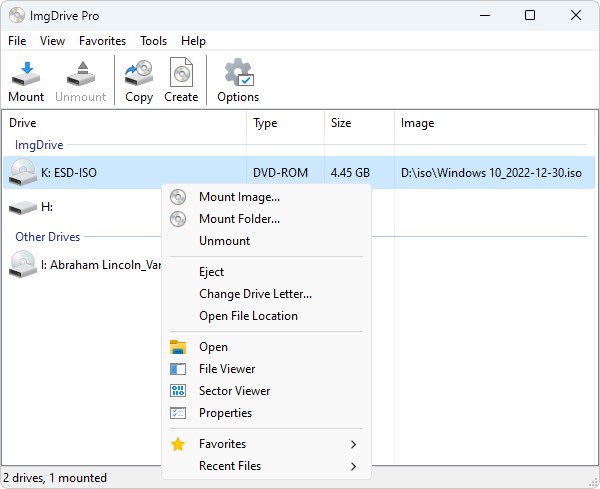
- Or open the main window. Right-click a drive row and choose Mount Image, then pick your file - this is the route to use when you want a specific drive letter.
- Open the drive. It appears under This PC with the image's contents, and installers, setup files and videos run straight from it.
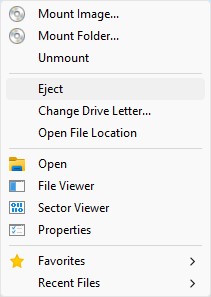
To change a drive letter, right-click the drive inside ImgDrive and choose Change Drive Letter. To add more virtual drives, use Number of Drives on the tray menu.
How to Unmount When You Are Done
Right-click the mounted drive inside ImgDrive and choose Eject. The tray menu also has Unmount All Drives, which is quicker when you have several open.
You can also right-click the drive under This PC and choose Eject, exactly as you would with a real disc.
What the Free Version Leaves Out
ImgDrive is genuinely free for personal use, with no adware in the installer and no time limit. There is a Pro edition at around 10 US dollars, and it is worth knowing what sits behind it before you go looking for a missing button.
| Feature | Free | Pro |
|---|---|---|
| Virtual drives at once | Up to 4 | Up to 9 |
| ISO, IMG, CUE, NRG, MDS, CCD, ISZ | Yes | Yes |
| B5T, B6T, BWT, CDI, MDX, PDI, UIF, ASHDISC, MDS v2.0 | No | Yes |
| Audio CD images | CUE with WAV, APE or FLAC | Adds M4A, TTA and WavPack |
| Mounting a plain folder as a drive | Up to 30 files | No limit |
| Creating an image from a folder or a disc | No | Yes |
| Blu-ray drive emulation with AACS-Auth | No | Yes |
| Use at work | No | Yes |
For the job this guide is about - opening a disc image and reading what is inside it - the free version is complete.
Who Should Look Elsewhere
You only want one file out of the image. Do not mount anything. 7-Zip opens ISO, IMG, NRG and most BIN files like a zip archive, and you drag out what you need.
You need a real disc at the end. That is burning, not mounting - ImgBurn does it, and our guide to burning an ISO to DVD walks through the settings.
You are installing an operating system. A mounted image will not boot a PC. Put the ISO on a USB stick with Rufus, or fit several on one stick with Ventoy.
We have step-by-step guides for both: multiple ISOs on one USB with Ventoy and the same thing with YUMI exFAT.
Your image is a ripped audio CD. A CUE with a FLAC or APE beside it plays directly in foobar2000, and Exact Audio Copy will split it into tracks.
Backing something up rather than opening it. A disc image of your own files is not a backup plan on its own - see our guides on creating a Windows system image and making a bootable recovery drive.
Quick questions
Do I need to install anything to open an ISO in Windows 11?
No. Right-click the file and choose Mount, and Windows opens it as a new drive. You only need extra software for the formats Windows does not recognise, such as BIN/CUE, NRG, MDS and CCD.
Why do I get 'Sorry, there was a problem mounting the file'?
The file is on a network location, it has been NTFS-compressed, it is stored as a sparse file, or there is no free drive letter. Copying it into a normal folder on your C: drive fixes it almost every time.
I have a BIN file with no CUE. Can I still open it?
Not by mounting it, because the CUE is what describes the track layout. Open the BIN with 7-Zip instead, or write a short CUE file by hand if you know the disc type.
Is ImgDrive free, or is it a trial?
It is free for personal use with no time limit and no adware. A paid Pro edition adds more drives, more exotic formats and image creation, but mounting is not held back.
How many images can I have mounted at the same time?
Four with the free version, and nine with Pro. You set the number under Number of Drives on the tray menu.
Does mounting an image use extra disk space?
No. The virtual drive is only a window onto the file you already have, so a 4GB ISO still takes 4GB and not a byte more.
Check your file extension first, and only reach for a virtual drive when Windows will not take it.
Download ImgDrive and see how it handles your files, or tell us how you got on if you have used it before.


How to Stream With VLC: Open a Stream URL or ...
5/5This is amazing! I could no longer afford cable so I cut the cord and started watching Hulu, Youtube, ...
Read More →Don't Open a .xmpeg File Before Reading This
3/5It's never a good sign when the potential malware you downloaded has the EXACT same filename as the example. ...
Read More →Free Popular IPTV Playlist: Where to Get Fres...
3/5How can you create a DSTV channels on IPTV?
Read More →