Two opposite jobs both get called streaming in VLC - pasting in a link to watch something, and sending your own video out - and this covers both, quickest first.
Most people arriving here have been handed a link and want it to play.
That takes three clicks in VLC Media Player, so it goes first.
Broadcasting your own video is the longer job, and it starts halfway down.
Open a stream URL in VLC
- Open VLC, then choose Media and Open Network Stream. The shortcut is Ctrl and N together.
- Paste the full address into the box, including the
http://orrtsp://part at the front. - Click Play. A live stream may sit black for a few seconds while it fills its buffer.
On a phone or tablet. In VLC for Android, open the side menu and choose Streams, then paste the same address into the field at the top.
If you only want to check whether a link is alive before bothering with any of this, you can try it in our web player straight from the browser.
What a stream link actually looks like
The prefix tells you what you are dealing with, and whether VLC is even the right tool.
| Starts with | What it is |
|---|---|
http:// or https:// | A web stream or an IPTV channel. The most common kind by far |
Ends .m3u or .m3u8 | A playlist file, not a single channel. VLC loads the whole list at once |
rtsp:// | Usually a security camera, a doorbell or a recorder on your own network |
udp:// or rtp:// | A broadcast on your local network, often from another copy of VLC |
mms:// | Old Windows Media streaming. Rarely alive these days |
A web page address is not a stream address. Copying the link out of your browser bar gives VLC an HTML page rather than a video, which is the single most common reason a paste fails.
Where to get stream links
- Our roundup of free and legal IPTV playlists has fresh M3U links sorted by country and category.
- Our Stream Extractor pulls the real video address out of a page when all you have is the page itself.
- The Playlist Builder turns a pile of individual links into one M3U file you can open in a single go.
- You can also turn a YouTube playlist into an M3U and play it through VLC like any other list.
- If your provider gave you a username and a server instead of a link, read what Xtream Codes logins are first.
Stick to sources you are allowed to watch. Plenty of playlists circulating online rebroadcast paid channels without permission, and opening one in VLC does not make that legal where you live.
When the link will not open
- VLC says it is unable to open the MRL. The address is malformed, dead, or missing its prefix - our guide to the MRL error works through each case.
- The playlist loads but every channel is dead. Nothing is wrong at your end - free lists go stale within weeks, so fetch a current one.
- It plays for a few seconds then stalls. Raise the buffer: in the Open Network Stream window, tick Show more options and set Caching to 1500 ms or higher.
- Audio plays but the picture is black. A decoding problem rather than a network one, and usually H.265 - see playing HEVC files in VLC.
- It worked yesterday and not today. Many providers sign their links with a token that expires, so you need a freshly generated address.
Sending your own video out
This is the other half of the job: taking a file on your PC and serving it to another device on your network.
VLC does it with a wizard that is longer than it needs to be, and there is one setting in it that quietly decides whether any of it works. Install VLC first if you have not already.
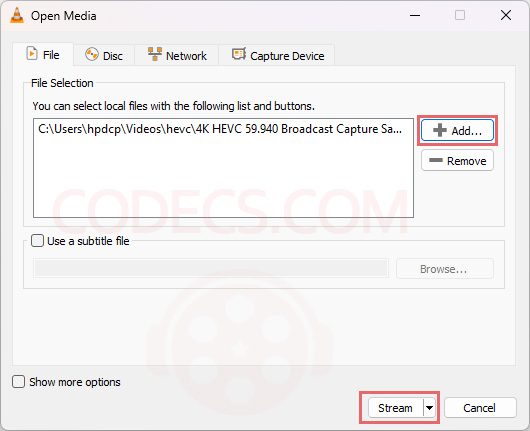
- Choose Media, then Stream. The shortcut is Ctrl and S.
- On the File tab, click Add, pick the video you want to send, then click Stream at the bottom.
- The Stream Output window opens on a summary of your source. Click Next.
- Pick your destination from the dropdown - HTTP is the right choice for almost everyone - then click Add.
- Leave the port at 8080 and the path at
/streamunless you have a reason to change them. Click Next. - Tick Activate Transcoding and choose the profile Video - H.264 + MP3 (TS). This is the step that matters, for the reason below.
- Click Next, then Stream. VLC now looks like it is playing nothing, which is normal - it is serving.
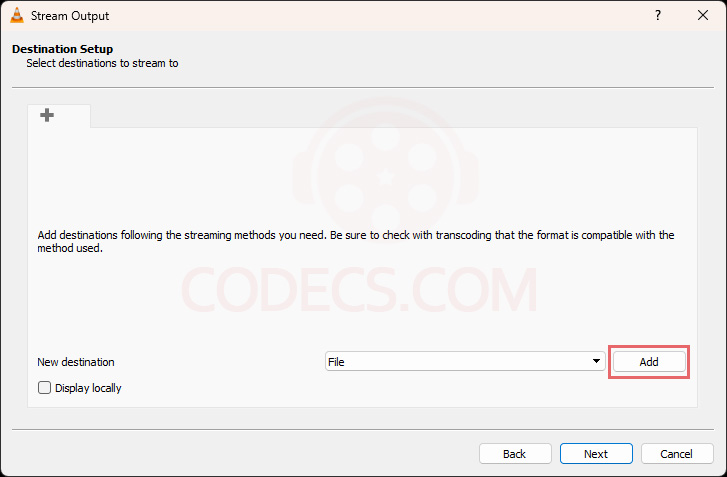
Tick Display locally on the destination screen if you also want the video playing on the sending PC.
Pick a profile that can actually stream
Most guides tell you to choose Video - H.264 + MP3 (MP4) here. That advice produces a stream nobody can open.
An MP4 file keeps its index in one lump, which works beautifully on a hard drive and not at all down a network cable. VideoLAN's own compatibility table lists MP4 as supported for file output only, and as unsupported for HTTP, RTSP, UDP and RTP alike.
Use a TS profile for anything leaving your PC. Video - H.264 + MP3 (TS) carries the same H.264 video in a container built for streaming, and it is the only reason most people's first attempt fails or succeeds.
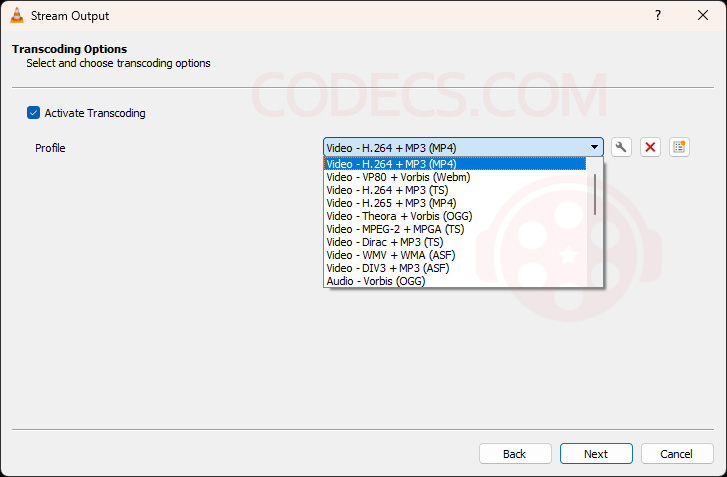
Transcoding also costs processor time on the sending machine. If the source file is already H.264 in a TS or MKV container, you can untick Activate Transcoding entirely and VLC will pass it through untouched.
Finding the address your viewers need
The sending PC knows itself as localhost, but no other device does, so you need its address on the network.
- Press the Windows key and R, type
cmdand press Enter. - Type
ipconfigand look for IPv4 Address. It will read something like192.168.1.42. - On the other device, open VLC, press Ctrl and N, and enter
http://192.168.1.42:8080/streamwith your own number in place of that one.
The firewall prompt appears once. Windows asks whether to allow VLC through the moment you first click Stream, and if Private networks is left unticked the stream is unreachable with no other symptom.
Which output method to pick
| Method | When it is the right one |
|---|---|
| HTTP | One or a handful of viewers on your own network. Easiest to set up and easiest to connect to |
| RTSP | Mainly for camera-style setups. VLC's RTSP server is basic and worth avoiding unless something specifically needs it |
| UDP or RTP | Many viewers at once on a wired network. No rewind, and it copes badly with Wi-Fi |
| File | Not streaming at all. This just saves a converted copy - see converting files with VLC |
Easier ways to do the same thing
The wizard is worth knowing, but it is rarely the shortest path any more.
- Casting to a TV. Play the file normally, then choose Playback and Renderer and pick your Chromecast - no wizard and no addresses.
- A permanent home setup. Kodi serves a whole library with artwork and resume points, which VLC was never built to do.
- A second opinion on Windows. Our guide to streaming with MPC-HC covers a lighter alternative, and there are other media players worth a look.
- Capturing rather than sending. If what you actually want is a video of your own screen, that is recording your screen with VLC instead.
Quick questions
How do I open a stream link in VLC?
Media, then Open Network Stream, or Ctrl and N. Paste the full address including the http:// part and click Play. On VLC for Android it is the Streams entry in the side menu.
Why does my VLC stream play on this PC but not on any other device?
Two usual causes. You gave the other device the localhost address instead of your real network address, or Windows Firewall blocked VLC on private networks when it asked.
Which profile should I use for streaming?
Video - H.264 + MP3 (TS). MP4 profiles only work when you are saving to a file, so choosing one for an HTTP, RTSP or UDP stream gives you something no player can open.
Where can I get free stream links for VLC?
Our guide to free and legal IPTV playlists lists current M3U sources by country. Free lists go stale quickly, so expect to refresh them every few weeks.
Can VLC stream to a phone or a smart TV?
Yes, if the device has a player that opens network addresses, which VLC for Android does. For a Chromecast, skip the wizard entirely and use Playback and Renderer instead.
Does any of this work on Mac and Linux?
The viewer side is identical, with Cmd and N in place of Ctrl and N on VLC for Mac. The stream wizard exists on both, though the window layout differs a little from the Windows screenshots above.


How to Stream With VLC: Open a Stream URL or ...
5/5This is amazing! I could no longer afford cable so I cut the cord and started watching Hulu, Youtube, ...
Read More →Don't Open a .xmpeg File Before Reading This
3/5It's never a good sign when the potential malware you downloaded has the EXACT same filename as the example. ...
Read More →Free Popular IPTV Playlist: Where to Get Fres...
3/5How can you create a DSTV channels on IPTV?
Read More →