Sports broadcasters want VPN companies to block pirate IPTV streams, and this autumn that push reached courts in France and Spain and lawmakers in the US.

If you use a VPN for privacy or watch legal IPTV, nothing you do has become illegal.
The rules around VPNs are changing fast, though, and the next few months will decide how far they go.
Here is what happened, what is still being decided and what it means for you.
Where Blocking Can Happen
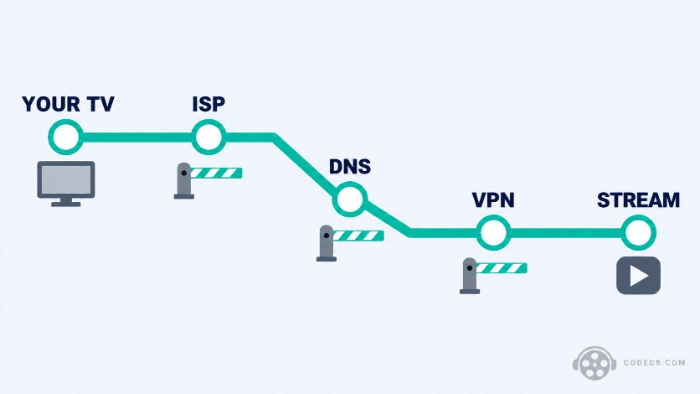
When you open a stream, your request passes three places that a court can order to block it:
- Your internet provider (ISP). This is the company you pay for your home or mobile connection, and the usual target of blocking orders.
- The DNS service. DNS is the internet's address book, and blocking there means it simply refuses to look up the site's name.
- Your VPN. A VPN sends your traffic through its own servers and skips the first two blocks, which is exactly why broadcasters now want VPNs to block too.
France: VPNs Must Try, Not Guarantee
In May, a Paris court ordered several VPN companies, including NordVPN, Surfshark and Proton, to block about a dozen sites streaming WTA tennis without permission. The request came from beIN Sports, which holds the French rights.
beIN later complained that too many sites still worked and asked for fines of 10,000 euros a day for each one. On 7 October the court said no: providers must make a "reasonable effort", but they do not have to guarantee every site disappears.
That is a low bar in practice. NordVPN and Surfshark blocked 6 of 11 sites, and only for people using their French servers, as TorrentFreak reported.
Quad9, a free non-profit DNS service, is the one still refusing. It has blocked none of the 58 sites on its list, beIN wants 580,000 euros a day, and a ruling is due later this month. Quad9 says leaving France is one of its options.
France is also speeding things up. A law passed in July lets new sites be added to a block list during a live match, with the regulator checking afterwards.
The US: Two Bills, One Big Difference
In September, two site-blocking bills were introduced in Congress, the first serious attempt since the SOPA protests of 2012. Both would let courts order companies to block foreign pirate sites, including live sports streams. The big difference is VPNs:
| Who can be told to block | ACPA (Rep. Issa) | DEFEND IP Act (Lofgren, Tillis) |
|---|---|---|
| VPNs | Yes, with 100,000+ US users | No, VPNs are left out |
| Internet providers | 100,000+ users | 50,000+ subscribers |
| DNS services | Yes | Only big public ones, over $100 million a year |
| Which sites | Foreign pirate sites only | Foreign pirate sites only |
Neither bill punishes anyone for using a VPN. Both die if they do not pass before this Congress ends in January, and both lead sponsors are leaving, as TorrentFreak's comparison notes.
Spain: LaLiga Takes Its Case to the EU
Spain's football league has asked the European Commission to put NordVPN, ProtonVPN, ExpressVPN and Surfshark on its 2027 Piracy Watch List. LaLiga says its problem is not the technology but affiliate websites that publish "watch football free with a VPN" guides and earn money on each sign-up.
The watch list names and shames, but it has no legal force. In court, Spain has gone further: a judge in Cordoba ordered ProtonVPN and NordVPN to block pirate football streams in February, but in May refused to fine NordVPN because the streams kept changing address.
The same submission also targets Downloader, the popular Fire TV app, saying most of the short codes it checked led to pirate apps. Its developer replies that anyone can create a code, and that he removes pirate ones when reported.
What It Means for You
- Using a VPN is still legal. Nothing in France, Spain or the US punishes people for having one - the orders and bills are aimed at the companies.
- Legal IPTV is not the target. Every order so far names pirate sports sites, not free channels or IPTV player apps.
- A VPN is no longer a sure way around a block. Some providers now block listed sites on their French servers, and more countries are pushing the same way.
- Privacy is still a good reason to use one. On public Wi-Fi, a VPN keeps your traffic away from whoever runs the network, and Proton VPN has a free plan for Windows and Android.
Free sports streams are the main target:
Every court case here began with live football or tennis. If a site offers every match free, it is exactly what these orders are written for - our free football IPTV playlist guide shows what you can watch legally.
What to Watch Next
- Late October: the Paris ruling on Quad9, and whether it leaves France.
- No date yet: France's Supreme Court on DNS blocking. A VPN appeal was paused on 30 September to wait for it.
- By January: whether either US bill passes before Congress ends.
- Spring 2027: the EU Piracy Watch List, and whether any VPN is on it for the first time.
Quick questions
Is it illegal to use a VPN for IPTV?
No. Using a VPN is legal in France, Spain, the US and most countries. Watching pirated streams is what can be illegal, with or without a VPN - our guide Is IPTV legal? explains how to tell the difference.
Will my VPN stop working with my IPTV app?
Not for legal IPTV. The orders cover lists of named pirate sites, so free channels and legal playlists keep working as before.
Do the US bills ban VPNs?
No. One bill, the ACPA, would let courts order large VPN companies to block foreign pirate sites. The other, the DEFEND IP Act, leaves VPNs out completely.
Which VPNs have been ordered to block sites?
In France, NordVPN, Surfshark, Proton and CyberGhost have all faced orders over pirate sports streams. In Spain, a court named ProtonVPN and NordVPN.
What is a DNS service?
It is the internet's address book. When you type a site's name, a DNS service finds the number your device needs to connect, and blocking there means it refuses to answer for that site.
The bottom line
Broadcasters want VPNs to block pirate streams, but so far courts only ask for a reasonable effort, and nobody is punishing ordinary VPN users. If you stick to legal IPTV, the only thing that changes is the headlines.


Latest comments
AllFree M3U Playlist for TiviMate: Legal Lists That Load Cleanl...
The link isn't working. https://www.free-codecs.com/guides/free-epg-urls-for-iptv.htm
The New Fire TV Stick 4K Can't Run Kodi - Here's Which Fire ...
The Vega OS shift is the biggest Firestick story of 2026. Anyone buying now needs to know: 4K Max = sideloading ...
JPEG XL Is Back in Chrome: What It Means and How to Open JXL...
Brave just enabled it by default for stable users yesterday (1.97). Not specified is chromeOS will be passively gaining decode ...