MediaHuman Audio Converter turns a folder of audio into Opus in about four clicks, and the only decision that really matters is what you feed it.
Opus packs cleaner sound into a smaller file than MP3 does, particularly at lower bitrates.
MediaHuman Audio Converter is free, runs on Windows and macOS, and converts whole folders at once.
Start with the bit that most walkthroughs skip.
Convert From Lossless, Not From MP3
Opus is a lossy format, and so is MP3. Converting one into the other throws data away a second time, on top of what MP3 already discarded.
The file gets smaller. It does not get better, and it cannot get back what was already gone.
So convert from FLAC, WAV, ALAC or AIFF wherever you have them, and treat an MP3 source as a compromise you are making on purpose.
Converting MP3 to Opus is still reasonable when the goal is space rather than quality, such as fitting a large library onto a phone. Just keep the originals, because the conversion is one-way.
Add Your Files
Open MediaHuman Audio Converter and click Add file(s) for conversion in the toolbar.
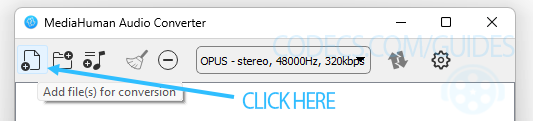
Dragging files or a whole folder onto the window does the same thing, and it is quicker for a large batch.
Choose Opus as the Output Format
At the top of the window, open the Output format drop-down and pick OPUS.
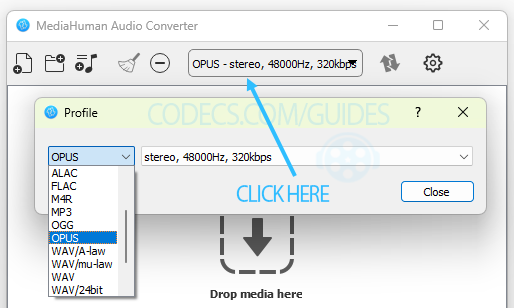
The setting applies to everything in the list, so you set it once for the whole batch.
Set the Bitrate, or Leave It Alone
The gear icon beside Start conversion opens the settings, where bitrate, channels and sample rate live.
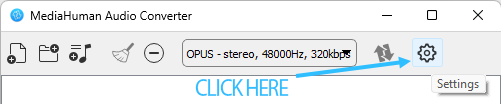
The defaults are fine for most people, and this is the one screen where guessing wrongly costs you real quality.
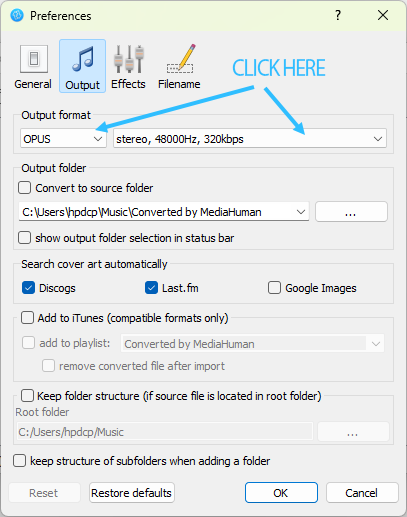
If you do want to set it yourself, around 96 to 128 kbps is generous for stereo music, and Opus holds up better down there than MP3 does. For a podcast or a spoken recording, 64 kbps is plenty and 32 kbps mono is usable.
Leave the sample rate as it is unless you know why you are changing it. Resampling is another quiet way to lose quality for nothing.
Pick a Folder and Convert
Use Browse to choose where the finished files land, and keep it separate from the originals so you can tell them apart later.
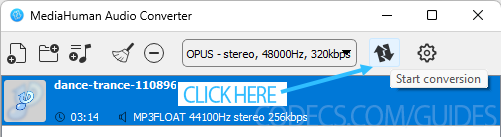
Click Start conversion. Each file gets its own progress bar, and a large batch runs unattended.
The finished files carry the .opus extension and keep their tags.
Will Your Files Actually Play?
Mostly yes, and this is worth checking before you convert a library rather than after.
Android, Windows 11 and every current browser handle Opus. iPhones need a player that carries its own decoder, and car stereos are the common place it falls down.
Our guide on what actually plays Opus goes device by device. If a file refuses to open anywhere, VLC Media Player plays Opus out of the box on every platform.
Who Should Look Elsewhere
Here is the tell, and you can check it in a minute without installing anything: put one Opus file on the device you actually listen on, and try to play it.
If your listening happens in a car, on an older hi-fi streamer or on a device that predates about 2018, MP3 or AAC will save you the argument. Universal support beats efficiency when the file has to play on hardware you cannot update.
MediaHuman is also the wrong tool if you want fine control over encoder settings rather than a bitrate slider. It is built to be simple, and that is the trade.
Quick questions
Is MediaHuman Audio Converter free?
Yes, it is freeware with no paid tier and no conversion limit. It runs on Windows 7 through 11 and on macOS 10.12 or later.
Will converting MP3 to Opus improve the sound?
No. Both formats are lossy, so the conversion can only lose more. It makes the file smaller, which is a fair reason to do it, but the quality does not go up.
What bitrate should I use for music?
Around 96 to 128 kbps stereo is comfortable for most listening, and Opus stays cleaner than MP3 at the low end of that. Go higher only if you can hear the difference on your own equipment.
Can it convert a whole folder at once?
Yes. Drag the folder in, set the output format once, and it works through the lot. It also splits a single album file into tracks when a CUE sheet sits beside it.
Do I need to install an Opus codec first?
Not for the conversion. MediaHuman bundles what it needs, so nothing extra has to be installed to write Opus files.
Why is my Opus file silent in one app but fine in another?
That app has no Opus decoder, which is common in older players and in some car systems. Open it in VLC to confirm the file itself is fine.
Feed it lossless, leave the bitrate alone, and the rest is one button.
Download MediaHuman Audio Converter and put a folder through it, or tell us what you are converting for if you have already been using it.



Don't Open a .xmpeg File Before Reading This
3/5It's never a good sign when the potential malware you downloaded has the EXACT same filename as the example. ...
Read More →Free Popular IPTV Playlist: Where to Get Fres...
3/5How can you create a DSTV channels on IPTV?
Read More →How to Download HEVC Video Extension for Free
5/5Does anyone have the HEVC Video Extensions as an .exe file and can provide a download link?
Read More →