Audacity will not open your .m4a file, or the export format you want is missing from the list. That is not a broken install - it is one component Audacity is not allowed to ship, and adding it takes about two minutes.
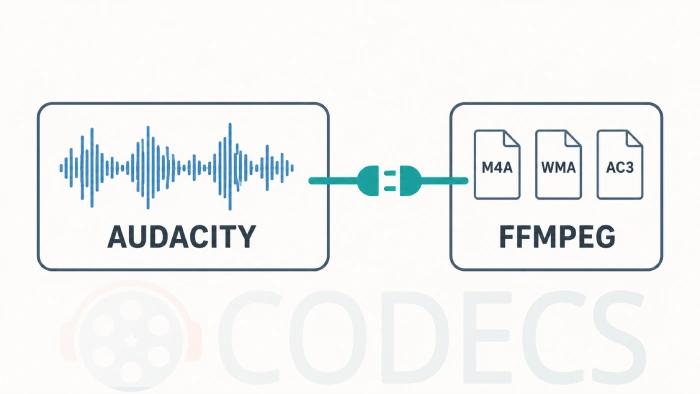
The component is called FFmpeg, and installing it is genuinely a two-minute job.
The step that trips people up is the last one, so that is covered in detail further down.
Audacity handles WAV, AIFF, MP3 and AU on its own.
It reads and writes FLAC and Ogg Vorbis unaided too.
Everything past that list needs FFmpeg bolted on.
Check this first: if the only thing you want is MP3 export, stop here - you already have it.
MP3 patents expired in 2017, and Audacity has bundled the LAME encoder on Windows and macOS since version 3.2. Older guides telling you to install LAME separately are out of date, and that includes some still linked from download pages.
What FFmpeg Actually Adds
Worth knowing before you install anything, so you are not chasing a fix for a problem you do not have.
| Format | Without FFmpeg | With FFmpeg |
|---|---|---|
| WAV, AIFF, FLAC, Ogg Vorbis, AU | Import and export | No change |
| MP3 | Import and export | No change on Windows or macOS |
| M4A and AAC | Nothing | Import and export |
| WMA | Nothing | Import and export |
| AC3 | Nothing | Import and export |
| Audio inside MP4, MKV, AVI, MOV | Nothing | Import the audio track |
One caveat on the format lists you will see elsewhere. AMR is often listed, but it is not enabled in the recommended FFmpeg build, so do not count on it.
Opus is worth a mention too, since it turns up in downloaded voice and game audio - our OPUS audio codec FAQ covers what it is and how to play it. The audio codecs section has the rest of the family.
Step 1: Download the Right Build
The build has to match your Audacity version, and on Mac it has to match your processor. Getting this wrong is the main cause of the error further down this page.
Windows. Both installers sit on our Audacity download page, under the main Audacity files - pick FFmpeg_5.0.0_for_Audacity_on_Windows_x86_64.exe unless you are on a 32-bit system.
macOS. We do not host the Mac package, so get the universal installer from the official FFmpeg for Audacity page. It matches your architecture automatically and needs macOS 12 Monterey or newer.
Linux. Use your package manager rather than an installer. On Debian, Ubuntu or Mint that is sudo apt install ffmpeg lame, and on Fedora sudo dnf install ffmpeg lame after adding RPM Fusion.
Apple Silicon owners, one thing to check. Your Audacity and your FFmpeg have to be the same architecture - arm64 Audacity needs arm64 FFmpeg, Intel needs Intel. A mismatch here looks exactly like a failed install.
Step 2: Run It and Restart Audacity
Run the installer and accept the default location. On Windows that is C:\Program Files\FFmpeg for Audacity, which is where Audacity already looks.
Windows will probably warn you about an unknown publisher. That is expected for this installer and you can continue.
Then close Audacity completely and open it again. That restart is not optional - Audacity only scans for libraries at startup.
For most people that is the whole job. Open a .m4a file and it will simply work.
Step 3: Only If Audacity Still Cannot See It
If the format is still unavailable after a restart, you need to point Audacity at the library by hand.
Go to Edit > Preferences > Libraries on Windows and Linux, or Audacity > Preferences > Libraries on macOS. Then click Locate next to the FFmpeg library.
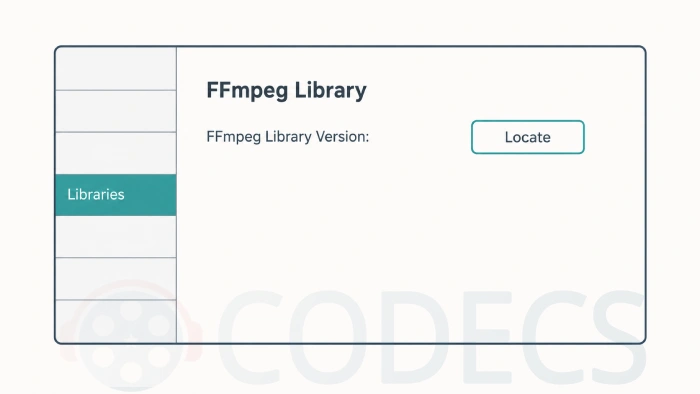
If a message pops up saying Audacity has already found FFmpeg, click No - it knows where the library is and you are finished.
If no message appears, click Browse and go to the FFmpeg for Audacity folder. You are looking for a file named avformat-59.dll on Windows, avformat.59.dylib on macOS, or libavformat.so.59 on Linux.
Select it, click Open, then OK twice to close preferences.
The 59 in that filename is the FFmpeg 5.0 version number, not a typo.
Older guides tell you to look for avformat-55.dll, which belongs to FFmpeg builds from the Audacity 2.x era. If you install FFmpeg 5.0 and then hunt for a file numbered 55, you will not find it and will assume the download failed.
The rule: browse to the folder and open whichever avformat- file is actually in there.
Fixing "FFmpeg Library Not Found"
This is the error people arrive here with, and after a clean install it almost always means a version mismatch rather than a missing file.
Audacity only accepts specific avformat versions, and which ones depends on your Audacity release. Check yours against this before reinstalling anything.
| Your Audacity version | avformat versions it accepts | What to install |
|---|---|---|
| Before 3.1 | 55 only | Update Audacity instead |
| 3.1 | 55, 57, 58 | Update Audacity instead |
| 3.2 to 3.4 | 55, 57, 58, 59, 60 | FFmpeg 5.0, the recommended build |
| 3.5 or 3.6 | Adds 61 | FFmpeg 5.0 is still fine |
| 3.7 or newer | Adds 62 | FFmpeg 5.0 is still fine |
Two other things cause it. Grabbing a loose avformat file instead of a full FFmpeg package will never work, and neither will a static build - Audacity needs the shared build, the one that actually contains .dll or .dylib files.
Development builds from FFmpeg's master branch are also unsupported. Match the release to your Audacity version and skip the newest thing you can find.
Why Audacity Does Not Just Include It
Patents, but not the ones people usually assume. Audacity is free and open source, and shipping FFmpeg would drag patent-licensed decoders into a program that has no licensing budget.
The formats affected are the proprietary ones - M4A and AAC, WMA, AC3. Distributing FFmpeg separately keeps that liability with the user rather than the project.
MP3 used to be on that list and no longer is, which is why the LAME step disappeared from modern Audacity. If a guide still tells you to install LAME on Windows or macOS, it predates version 3.2.
Worth being clear that this build is not the full FFmpeg toolkit - it is the decoding libraries only, with no command line attached. If you want the actual program, our guide to installing FFmpeg properly on Windows covers that, and encoding AV1 with FFmpeg shows what it can do once you have it.
If You Would Rather Not Install Anything
Converting the file first is a perfectly reasonable alternative, particularly for a one-off.
Our online audio converter turns an .m4a into a .wav in the browser, and Audacity opens .wav with nothing added. If you are not sure what is actually inside the file, Codec Finder will tell you.
For desktop conversion, our Helium Audio Converter guide covers a straightforward free option, and the Audio Encoders category lists the rest.
Some editors simply include their own decoders, so the whole problem never comes up.
- ocenaudio - opens M4A and WMA out of the box, and is the closest thing to Audacity without the setup.
- REAPER - the step up for multitrack work, with a generous evaluation period.
- mp3DirectCut - the fast pick for trimming MP3s without re-encoding them.
- WavePad - free for non-commercial use, with a paid tier if you outgrow it.
The full Audio Editors category has the rest, and CUETools is the specialist if you are working from CUE sheets and lossless rips.
A Note on Audacity 4
Audacity 4.0 is in beta and available on our download page alongside the stable 3.7.8 release.
FFmpeg works the same way there, but the interface has moved things around, so if a menu path above does not match what you see, check whether you are running the beta. The stable branch is the safer place to be if you just want the file to open.
Quick questions
Do I need FFmpeg to export MP3 from Audacity?
No. Audacity has included the LAME MP3 encoder on Windows and macOS since version 3.2, so MP3 export works with nothing extra. Linux users install LAME through the package manager alongside FFmpeg.
Which FFmpeg version should I install?
The recommended FFmpeg 5.0 build for Audacity, which supplies avformat 59 and works with every Audacity release from 3.2 onward. Newer is not better here, because Audacity only accepts specific versions.
Audacity says the FFmpeg library was not found. Now what?
Restart Audacity first, since it only looks for libraries at startup. If that does not do it, check your Audacity version against the compatibility table above, then point Audacity at the file manually through Edit > Preferences > Libraries.
Is FFmpeg for Audacity safe to install?
Yes, when you take it from our download page or the official FFmpeg for Audacity site. Windows will warn about an unknown publisher because the installer is not code-signed, which is expected rather than a red flag.
Can I use an FFmpeg I already installed for something else?
Often yes, provided it is a shared build rather than a static one and its avformat version is on Audacity's supported list. Point Audacity at it manually, since it will not find a custom location on its own.
Do I have to reinstall FFmpeg when Audacity updates?
No. Audacity remembers the library location across updates, and newer releases keep accepting older avformat versions rather than dropping them.


How to Stream With VLC: Open a Stream URL or ...
5/5This is amazing! I could no longer afford cable so I cut the cord and started watching Hulu, Youtube, ...
Read More →Don't Open a .xmpeg File Before Reading This
3/5It's never a good sign when the potential malware you downloaded has the EXACT same filename as the example. ...
Read More →Free Popular IPTV Playlist: Where to Get Fres...
3/5How can you create a DSTV channels on IPTV?
Read More →