In March 2024, Google quietly swapped the software that decodes AV1 video on Android phones, and that change is still doing its work today.
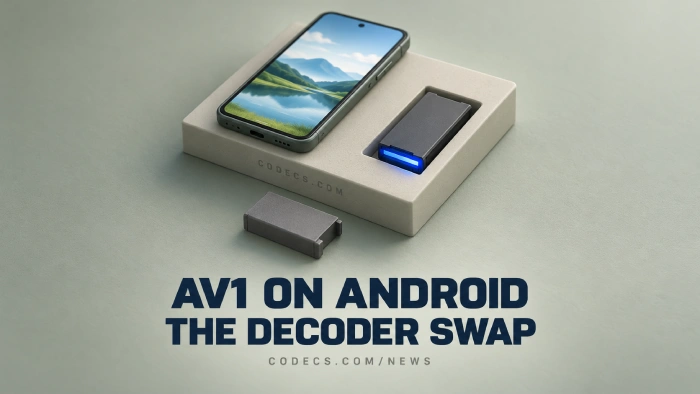
The new decoder is libdav1d, built by the VideoLAN team behind VLC.
It replaced libgav1, Google's own AV1 decoder, and it does the same job using less of your phone's processor.
That matters most on cheaper phones, which have no dedicated AV1 chip and have to do the decoding in software.
This article covers the March 2024 rollout. For where AV1 on Android stands now, and how to get AV1 files playing on your own phone, read How to Get the AV1 Codec on Android.
What AV1 is, in one paragraph
AV1 is a video format from the Alliance for Open Media, designed to fit the same picture quality into a smaller file than older formats manage.
Smaller files mean less mobile data and less buffering, which is why streaming services moved to it. The trade is that AV1 takes more effort to decode, so the software doing the decoding matters.
What Google actually changed
The March 2024 Google Play System Update delivered libdav1d to devices running Android 12 and newer. In April 2024, Android system development manager Arif Dikici confirmed that it would become Android's default AV1 software decoder.
Because it arrived through a Google Play System Update rather than a full Android release, there was no second announcement to mark the switch. The baseline target was smooth 720p30 playback on low-end hardware.
Compared with libgav1, libdav1d decodes the same video using noticeably less processor time. Less processor time means less heat, less battery drain and fewer dropped frames.
Software decoding is the fallback, not the goal
Hardware decoding is still the better outcome, because a dedicated block in the chip does the work and the battery barely notices.
Android flagships built on Snapdragon 8 Gen 1 or MediaTek Dimensity 9000 and later decode AV1 in hardware, and so do Google's Tensor chips. Mid-range phones have been catching up since.
Google has since made this a rule rather than a hope. The Android 16 Compatibility Definition Document lists AV1 among the formats a handheld device must be able to decode.
You can check what your own browser and device decode in hardware with our codec checker.
If AV1 still will not play on your phone
There is no AV1 codec file to download and install on Android. The decoder lives inside the system or inside the player app, so the fix is a player, never a codec pack.
VLC for Android carries its own copy of dav1d and plays AV1 whatever your phone's chip supports. mpv for Android does the same without ads.
MX Player also decodes AV1 out of the box if you prefer its interface.
Where this ended up
The libdav1d switch was one of those updates nobody celebrates and everybody benefits from. It moved AV1 on Android from a flagship feature to something a budget phone handles.
AV1 has since become one of the most-used formats on the internet, which we covered in AV1 Codec Dominates Streaming Landscape as 2026 Begins.
If you want the format compared against its main rival, read AV1 vs H.265. For the desktop side, there is How to Enable AV1 Decoding.
The short version
If AV1 video stutters or refuses to open on your phone, it is almost always the app rather than the phone, and a player that carries its own decoder usually fixes it.
Get dav1d if you want the decoder itself for a desktop player, or tell us how AV1 behaves on your device if you have hit this.



How to Stream With VLC: Open a Stream URL or ...
5/5This is amazing! I could no longer afford cable so I cut the cord and started watching Hulu, Youtube, ...
Read More →Don't Open a .xmpeg File Before Reading This
3/5It's never a good sign when the potential malware you downloaded has the EXACT same filename as the example. ...
Read More →Free Popular IPTV Playlist: Where to Get Fres...
3/5How can you create a DSTV channels on IPTV?
Read More →